
Quick answer: A Thermador refrigerator that is not cooling or is suddenly noisy is usually struggling to release heat. The most common causes are a failed defrost heater that lets the evaporator coil ice over, a dirty condenser or blocked ventilation grille, a failing condenser or evaporator fan, or a worn door gasket. South Florida heat and humidity make all of these more likely. Check the temperature with a thermometer (35–38°F fresh food, 0°F freezer), clear the grille, and test the door seals. If the fresh-food section stays above 40°F or a loud buzz, grind, or repeated click continues, book a technician.
A Thermador refrigerator that stops cooling or starts making a new noise is usually telling you the same thing: the system is working harder than it should. In South Florida homes, heat, humidity, and storm-season power problems make that more common. This guide covers which sounds are normal, what you can safely check yourself, and when to book Thermador refrigerator repair with ARS Repair Inc..

Why Thermador refrigerators struggle in Florida homes
Thermador built-in, Freedom, and column refrigerators are installed flush with cabinetry, so they depend on a clear ventilation grille and clean condenser to get rid of heat. Florida conditions add load to that system:
- High kitchen and ambient temperatures keep the compressor and condenser fan running longer, especially in summer or in homes where the A/C is set high while owners are away.
- Humidity makes worn or dirty door gaskets show up quickly as condensation, frost, or a warm fresh-food section.
- Dust, lint, and pet hair pack into the condenser behind the top or bottom grille faster than most owners expect.
- Power outages and surges after summer storms and hurricanes can stress control boards and fan motors.
- Seasonal homes sometimes sit for months with no one checking the refrigerator, so a small issue becomes spoiled food.
The U.S. Department of Energy notes that dirty condenser coils can raise a refrigerator’s energy use by as much as 35% and shorten its life. On a built-in unit, that extra strain often shows up first as noise or poor cooling.
Thermador refrigerator making noise: normal vs. not normal
Thermador use-and-care manuals list several sounds as normal operation, including a droning motor (compressor or fan), bubbling or gurgling as refrigerant flows, and clicking when switches, valves, or motors turn on and off. Ice makers also add water-fill buzzing and ice-drop sounds.
| What you hear | Usually normal? | What it can mean if it is new or loud |
|---|---|---|
| Low hum or drone | Yes | Compressor or fan running long hours to keep up with heat |
| Bubbling or gurgling | Yes | Refrigerant flow; rarely a concern on its own |
| Occasional click | Yes | Controls, valves, or defrost cycle switching |
| Loud buzzing that does not stop | No | Strained compressor, failing start components, or a fan struggling |
| Rattling or grinding | No | Condenser or evaporator fan blade hitting debris or ice, or a worn motor |
| Repeated clicking with no cooling | No | Compressor trying to start and shutting off |
| Squealing or chirping | No | Fan motor bearing wear |
A useful test: if the noise is new and the refrigerator is getting warmer, treat it as a cooling problem, not just a sound.
Thermador refrigerator not cooling: first checks
These checks are safe for owners and fix a surprising number of calls:
- Confirm the real temperature. Put an appliance thermometer in a glass of water on a middle shelf for a few hours. The Department of Energy recommends 35–38°F for the fresh-food section and 0°F for the freezer.
- Check the settings and modes. Make sure the temperature setting was not changed and that a special mode (such as vacation or Sabbath mode on models that have them) is not affecting operation. Your owner’s manual explains the modes on your model.
- Inspect the ventilation grille. On built-in and column models, the grille must be open and free of dust. Do not cover it with trim, towels, or décor.
- Look at the door seals. Close the door on a dollar bill. If it slides out easily, or you see frost or moisture along the edge, the gasket may not be sealing.
- Avoid blocking airflow inside. Overpacked shelves against the rear wall or vents can starve the fresh-food section of cold air.
- Allow time after an outage. After a power outage or reset, give the unit several hours to recover before judging it, and keep the doors closed.
If the freezer is cold but the fresh-food section is warm, airflow or defrost is often the issue. For warning signs of a failing compressor, see our guide on how to tell if a refrigerator compressor is bad.
Common causes a technician finds
When the basic checks do not solve it, these are the usual causes on Thermador built-in and column refrigerators:
- Dirty or blocked condenser: the unit runs constantly, gets loud, and still cannot hold temperature.
- Condenser fan motor failure: heat builds up around the compressor; often comes with buzzing or a hot grille.
- Evaporator fan motor failure or ice on the fan: grinding, rattling, or a fan that runs and stops; the freezer may stay cold while the fresh-food side warms.
- Defrost system fault: a failed defrost heater, sensor, or control lets ice build on the evaporator coil, airflow drops, and cooling fades over several days. This is one of the most common repairs we are seeing; see the field example below.
- Door gasket or hinge alignment issues: common on heavy panel-ready doors; humidity makes this show up fast.
- Control board or sensor problems: sometimes after a storm, surge, or outage.
- Sealed-system issues: compressor, refrigerant leak, or restriction. These need certified diagnosis and are not DIY repairs.
From our technicians: iced evaporator coil and failed defrost heater
One of the most common Thermador refrigerator repairs our technicians are seeing in South Florida right now follows the same pattern. The owner notices the fresh-food section slowly getting warmer over several days, sometimes with a new fan noise. When the technician removes the evaporator cover, the evaporator coil is packed with ice. Testing the defrost circuit shows the defrost heater element has failed.
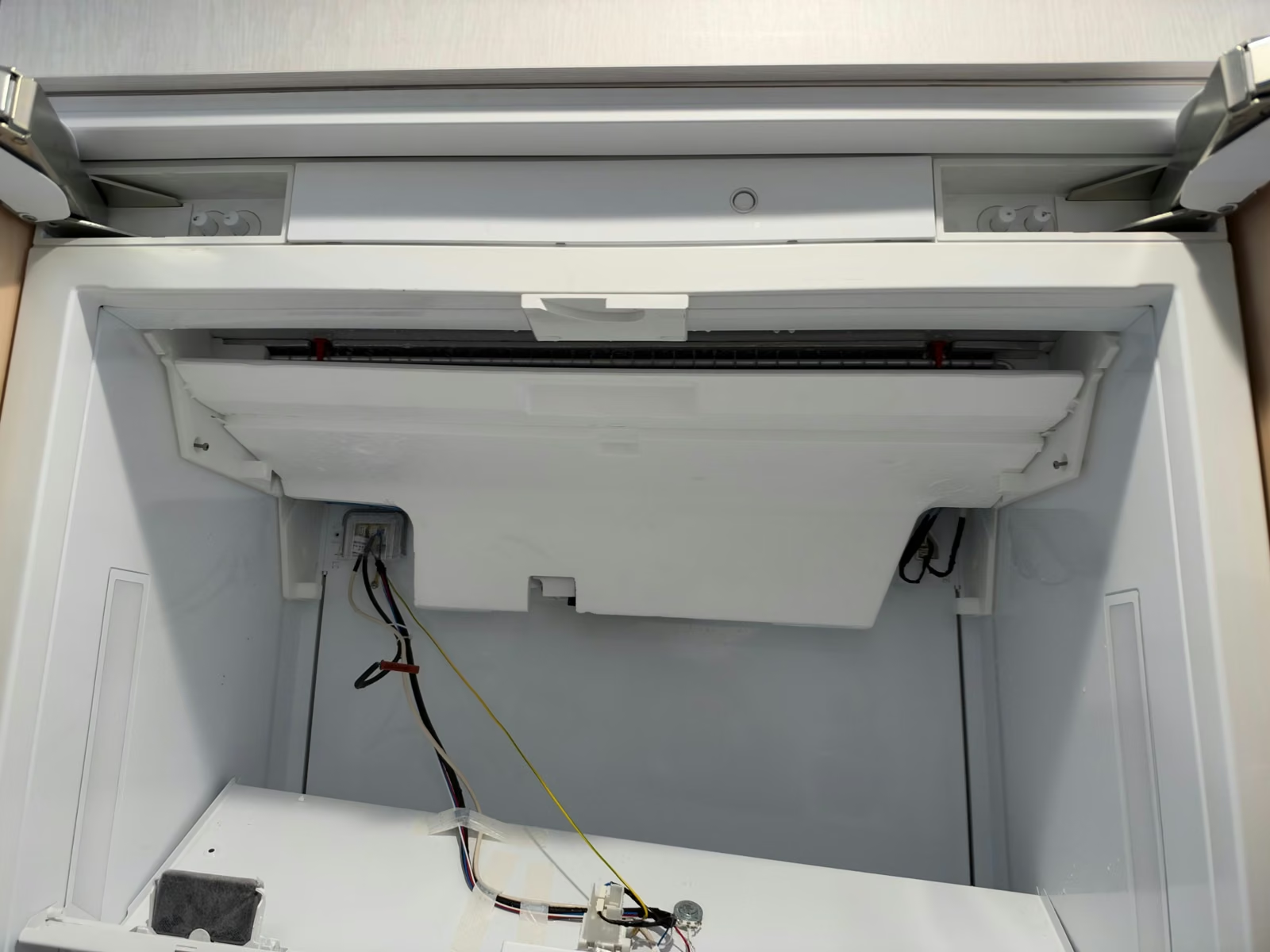
Here is why that causes a warm refrigerator:
- The evaporator coil makes the cold air. Every refrigerator builds a little frost on it during normal operation.
- The defrost heater melts that frost on a schedule so air can keep flowing through the coil.
- When the heater fails, frost keeps building until the coil is a solid block of ice.
- The fan can no longer push air through the coil, so cooling drops. The fan blades may also scrape the ice and make a grinding or rattling sound.
What we do: fully melt the ice, test the defrost heater, defrost sensor, and control signal, and replace the failed heater with an OEM Thermador part. Then we confirm the unit runs a normal defrost cycle and pulls back down to temperature.
Why not just defrost it? Manually melting the ice (or unplugging the refrigerator for a day) brings cooling back for a short time. If the heater is bad, the coil ices up again within days or weeks. The failed part has to be replaced.
When to call for Thermador refrigerator repair
Book a technician if any of these apply:
- The fresh-food section stays above 40°F after you have done the checks above.
- A loud buzzing, grinding, or clicking sound is new and does not stop.
- The refrigerator runs constantly and the grille area feels hot.
- Frost builds on the back wall, or water collects under the crisper drawers.
- The display shows an error or the unit acts up after a power outage.
Food safety matters too. The FDA and USDA say a refrigerator should stay at 40°F or below, because bacteria multiply quickly above that point. Do not wait days to see if a warm refrigerator recovers on its own.
ARS Repair Inc. services Thermador refrigerators across Miami-Dade, Broward, and Palm Beach counties, including built-in bottom-freezer, French door, Freedom, and column models. We diagnose first and give a clear estimate before any repair, using OEM Thermador parts. Start with our refrigerator repair page, see freezer repair for freezer column issues, or schedule service online.
Sources and further reading
- U.S. Department of Energy, Refrigerator Freezer Use and Temperature Tips (recommended temperatures, thermometers, airflow).
- U.S. Department of Energy, Purchasing and Maintaining Refrigerators and Freezers (condenser coil cleaning and energy use).
- U.S. Food and Drug Administration, Refrigerator Thermometers: Cold Facts about Food Safety (40°F safety limit).
- Thermador, Refrigeration Troubleshooting (official support and owner’s manual links).